
Blog · Updated October 7, 2026 · 7 min read
Apple Health Age: What It Is and How It Compares to Biological Age Apps
Apple's revamped Health app adds a Health Age metric in a new Longevity tab. Here's what it measures, how it differs from biological-age apps like HUMANITY and Bevel, and what it actually tells you.
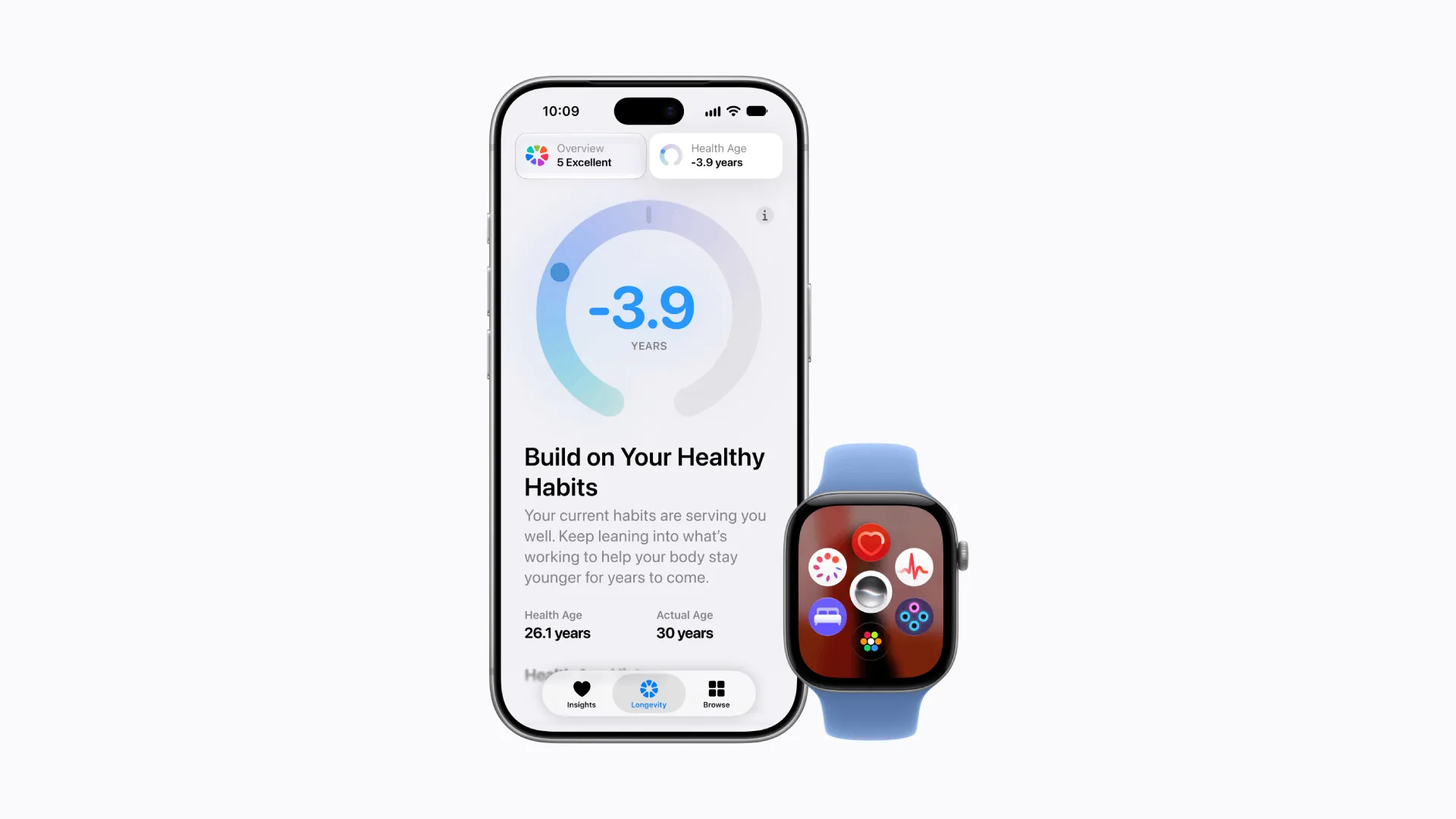
On September 9, 2026, Apple announced a redesigned Health app for iOS 27. Three things headline the update: an Insights tab, a 0-10 readiness score, and a Health Age metric in a new Longevity tab. Health Age requires an Apple Watch and runs on Apple Intelligence. The redesigned app arrives later this year, starting in U.S. English. Developers can already try it in the iOS 27.2 beta.
That last feature is the one worth understanding. It is a single number that tells you how old your body looks compared to your actual age. It sounds like a biological age app, and it is not quite that. Here is what it actually measures, what Apple has not told you, and how it stacks up against the apps that have been doing this for years.
The short answer
- Health Age is Apple's estimate of how certain health metrics track relative to your actual age, in the new Longevity tab.
- Apple has not published the exact inputs, weights, or algorithm. Treat it as a direction signal, not a precise measurement.
- Biological-age apps like HUMANITY and Bevel go further. They estimate a biological age number and a rate of aging, often from bloodwork.
- Health Age is a long-horizon signal. It will not tell you what to do today. That is a different problem.
- Don't want to wait? Our free biological age calculator gives you an estimate now from seven numbers in the Health app, and shows how many years each one adds or takes away.
What Health Age actually is
The Longevity tab analyzes your health data over time, including sleep, movement, and heart health, and Health Age shows how certain metrics track relative to your age. TechCrunch reported it uses data like VO2 max, sleep, and blood biomarkers. Lab results can be folded in too. Apple announced a Quest Diagnostics partnership for a 50-biomarker panel at $119, available through the Health app at roughly 2,000 Quest locations in the U.S.
What Apple has not done is publish the formula. There is no input list, no weights, and no validation paper. That is not unusual for Apple, but it matters here. A number like "your health age is 38 when you are 44" is only as useful as the method behind it, and Apple has kept that method private.
The honest limits
Three things to keep straight before you take any aging number seriously.
Population comparison vs personal trend. Health Age compares you to age norms, which is useful for orientation and says nothing about whether you are improving. The number that matters is your own trend over six or twelve months. A health age that drops from 44 to 41 is a signal. A single snapshot is not.
Biological age estimates vary by method. One app scores you from wearable data. Another scores you from bloodwork. A third adds DNA methylation. They will not agree, because they measure different things and all call the result "biological age." Do not chase the number across apps. Pick one method and watch its trend.
None of these are diagnoses. A "younger" health age is not a clean bill of health, and an "older" one is not a disease. These are wellness scores, not medical findings.
How biological-age apps differ
Apple is entering a category that already has serious players.
HUMANITY centers on rate of aging. It gives you a biological age, an H Score, and a rate-of-aging number, calculated from wearable data, blood tests, and DNA methylation. In August 2026 it partnered with Quest Diagnostics to sell a $29 biological age analysis as an add-on to routine bloodwork through questhealth.com. The model is validated against real-world health outcomes, and the claim is specific: the higher your H Score, the more likely you are to slow or reverse your aging trajectory.
Bevel 3.0 added a Biological Age metric powered by wearable data, daily habits, and bloodwork, recalculated weekly. You can upload blood tests and lab results, and Bevel extracts the biomarkers and feeds them into the score. It is the broadest of the three: recovery, strain, strength, labs, and aging in one app. Pro costs $14.99/mo or $99.99/yr.
| Apple Health Age | HUMANITY | Bevel 3.0 | |
|---|---|---|---|
| What you get | Health Age vs. actual age | Biological age, rate of aging, H Score | Biological age (weekly) |
| Inputs | Apple Watch + iPhone metrics, optional labs | Wearable + blood tests + DNA methylation | Wearable + daily habits + bloodwork |
| Bloodwork | Quest 50-biomarker panel, $119 | Quest $29 add-on | Health Records upload |
| Recalculated | Not published | Ongoing | Weekly |
| Price | Free with iPhone + Apple Watch | App free; labs extra | Free core; Pro $14.99/mo or $99.99/yr |
| Requires Apple Watch | Yes | No | No (Apple Watch, Garmin, others) |
Where Ness fits
Health Age answers a long-horizon question: am I aging well? It does not answer the short-horizon question of what to do today. Ness answers both.
Ness has its own Biological Age, built from seven Apple Health metrics: VO2 max, resting heart rate, heart rate variability, daily steps, exercise, sleep duration, and sleep consistency. Each one shows how many years it adds or takes away, so the number comes with its reasons. After 30 days you also see how it changed, and after 8 weeks, your pace of aging. It does not use bloodwork, and it is an estimate, not a clinical test. You can try the same idea in the free calculator.
For the short horizon, Ness is an AI health coach for iPhone and Apple Watch that reads Apple Health and turns your data into six daily scores: Health, Sleep, Recovery, Strain, Stress, and Energy. Every score is computed on the phone, not on a server. It also logs nutrition in more detail than a calorie counter, where photo, voice, barcode, or text search returns calories, macros, ~40 micronutrients, and 11 amino acids per ingredient. Its AI coach has memory, web search, and Fast and Pro modes, and it reasons from your meals, sleep, and recovery instead of a blank slate.
The connection aging apps miss is nutrition. Recovery is often a food problem, not a sleep problem. Health Age and biological age apps tell you the direction of your health over years. Ness can tell you that last night's late dinner is why your recovery is down today, and what to eat instead. AI features send anonymized queries to zero-data-retention providers after stripping personal details like your name from the request. Pricing is $12.99/month or $79.99/year, with a free trial to start. Ness is not a medical device.
The two time horizons work together. Check your Health Age once a month. Check your daily scores every morning.
How to choose
- Apple Health Age if you want a free, Apple-native long-horizon signal from hardware you already own.
- HUMANITY if you want a validated biological age and rate of aging from bloodwork.
- Bevel if you want biological age from wearable data, habits, and bloodwork in one app.
- Ness if you want a biological age from the Apple Watch you already own, with the reasons behind it, plus what to do today.
Sources
- Apple Newsroom. Introducing Apple Watch Series 12, with the all-new Health Sensing System. September 9, 2026. https://www.apple.com/newsroom/2026/09/introducing-apple-watch-series-12-with-the-all-new-health-sensing-system/. Covers the Longevity tab, the Apple Watch requirement for Health Age, the Quest 50-biomarker panel at $119, and the redesigned Health app arriving later this year.
- Perez S. Apple's revamped Health app will calculate your 'health age' and readiness score. TechCrunch, September 9, 2026. https://techcrunch.com/2026/09/09/apples-revamped-health-app-will-calculate-your-health-age-and-readiness-score/. Health Age uses VO2 max, sleep, and blood biomarkers, plus the Insights tab and readiness score.
- CNET. Apple's Redesigned Health App Brings a Slew of New Features. September 2026. https://www.cnet.com/tech/mobile/apple-redesigned-health-app/. Longevity tab with a health age comparing metrics to actual age.
- Quest Diagnostics Newsroom. Humanity Brings Biological Age Analysis to the U.S. Through questhealth.com. August 25, 2026. https://newsroom.questdiagnostics.com/2026-08-25-Humanity-Brings-Biological-Age-Analysis-to-the-U-S-Through-questhealth-com. The $29 biological age add-on and the validated model.
- HUMANITY. Stay healthy longer. https://humanity.health/. Rate of aging, biological age, and H Score.
- Bevel. Bevel 3.0 release notes. https://docs.bevel.health/release-notes. Biological Age from wearable data, daily habits, and bloodwork, recalculated weekly.
Nothing here is medical advice. Health apps and wellness scores are tools, not diagnoses; if you have symptoms or a health condition, see a physician.