Blog · August 14, 2026 · 9 min read
Luna Band vs Fitbit Air vs Apple Watch
The Luna Band is a $149 screenless tracker with free AI coaching, the Fitbit Air is a $99 tracker with a paid Gemini coach, and the Apple Watch Series 11 is a $399 smartwatch. Compare price, sensors, and whether free AI coaching is sustainable.

Three different ideas of what a wrist wearable is for, and one question underneath all of them: where does the intelligence come from? The Luna Band is a $149 screenless tracker from Lunazone, the company behind the Luna Ring, with an AI coaching layer that is free and subscription-free. The Fitbit Air is a $99.99 screenless pebble with Google's Gemini-powered Health Coach behind a $9.99-a-month Premium subscription. The Apple Watch Series 11 is a $399 smartwatch with a screen, ECG, and a day of battery.
The hardware comparison is straightforward. The interesting part is the coaching, because these three devices price intelligence three different ways: free, subscription, and bundled. One of those three, the free one, is not what it looks like.
The short answer
- Luna Band if you want a $149 screenless tracker with no subscription and a free AI coach, and you are comfortable betting that "free unlimited AI coaching" stays free and stays smart.
- Fitbit Air if you want the cheapest, lightest tracker in this group, with a proven Gemini-powered coach behind a $9.99/month subscription.
- Apple Watch Series 11 if you want a real smartwatch with a screen, ECG, GPS, and apps, and you will charge it daily.
- Any of these work with Ness for frontier-level health coaching at $7.99/month or $49.99/year, whichever band you pick.
What they have in common
All three track 24/7 heart rate, sleep stages, SpO2, and skin temperature, and all three ship an AI coaching layer. The Fitbit Air and the Apple Watch are each water resistant to 50 meters. All three feed Apple Health (the Air via the Google Health app's August 2026 update, the Watch natively, the Band through its LifeOS app), so your data lands in the same place whichever you pick. That is roughly where the overlap ends.
| Luna Band | Fitbit Air | Apple Watch Series 11 | |
|---|---|---|---|
| Price | $149 | $99.99 | from $399 (GPS) |
| Screen | None | None | Always-On Retina, up to 2000 nits |
| Battery | up to 10 days | up to 7 days | up to 24 hours (38h Low Power) |
| AI coach | LifeOS AI, free | Google Health Coach (Gemini), $9.99/mo or $99/yr | Apple Intelligence + Fitness+, $9.99/mo |
| Nutrition logging | Voice logging; plans on roadmap | No | No (third-party apps) |
| ECG | No | No | Yes |
| Onboard GPS | No | No | Yes |
| Works with Android | Yes | Yes | No |
| Apple Health sync | Yes | Yes (Aug 2026) | Native |
| First-year cost (device + sub) | $149 | ~$209 with Premium | ~$479 with Fitness+ |
Luna Band: the $149 screenless tracker with free AI coaching
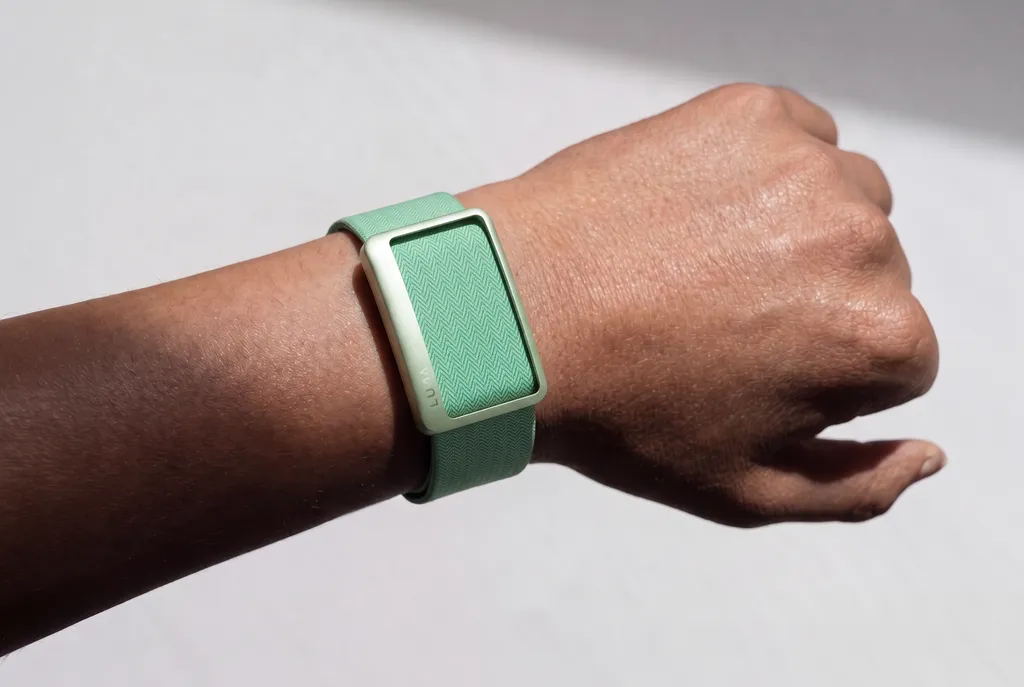
The Luna Band is Lunazone's answer to the screenless-tracker wave that Whoop started and the Fitbit Air made mainstream. It debuted at CES 2026 and is now on sale at $149. It is a lightweight, screenless band with cloth and silicone straps, PPG sensors, and Bluetooth Low Energy, worn on the wrist. It tracks 70+ metrics (sleep, activity, readiness, heart rate, HRV, SpO2, body temperature trends, and more) and auto-detects workouts including running and general cardio. Tom's Guide went hands-on at CES and called it "extremely comfortable, remarkably lightweight, and surprisingly stylish," noting that if the AI works as advertised, it could become the favorite affordable screenless tracker of 2026.
The differentiator is the software. The companion app, Luna: LifeOS AI, is described as "your body's intelligence engine": it turns your signals into a personalized daily plan, adds voice-led journaling, and lets you talk to an AI coach through your phone's assistant (Siri only for now) to ask for wellness advice or log food, stress, and other life events. A growing library of "micro-apps" covers stress, nutrition, training, supplements, and productivity. The band syncs to Apple Health, and the whole platform is free. Luna's FAQ states that "the Luna app and LifeOS platform are completely free for all users," with no subscription now or planned. The band is not a medical device, and Luna sells optional protection plans and replacement straps separately.
That is a genuinely attractive package on paper. The catch is the coaching economics, and it is a big one.
Why "free unlimited AI coaching" is a red flag
Frontier-model AI coaching costs real money per user, every month. That is why every serious AI health coach charges for the intelligence layer. Google Health Coach is $9.99 a month or $99 a year. Apple Fitness+ is $9.99 a month. Whoop runs $199 or more a year. Oura requires a membership. Those prices exist because running capable models over personal health data is expensive. Inference, memory, retrieval, and the engineering around them all carry ongoing costs. A $149 one-time hardware purchase cannot fund unlimited high-intelligence coaching for the life of the device. The math does not work.
So one of three things is true of Luna's free coaching. It runs on cheap, weak models that will not match what a paid coach delivers. The free tier gets degraded or paywalled once hardware sales slow, which is the classic bait-and-switch. Or the company is burning money on every user, which is not a plan, it is a countdown. None of those outcomes is good for you as a customer.
Luna's own product page hints at the gap between promise and delivery. Personalized nutrition plans are listed as "part of the LifeOS product roadmap," meaning a future update, not a shipped feature. The coaching layer is partly a promise, and the promise is free. When the intelligence is the most expensive part of the product and it is given away, the honest question is what you are actually getting.
None of this means the hardware is bad. At $149, a comfortable screenless tracker with no subscription is a real value, and the CES press was genuinely positive. The red flag is specific: unlimited high-intelligence AI coaching at that price point is not sustainable, so expect the coaching to be weaker than advertised, or to cost money eventually.
Fitbit Air: the $99 tracker with a paid Gemini coach
The Air is Google's answer to Whoop: a 5.2-gram polycarbonate pebble with no display and no buttons, worn 24/7, collecting heart rate, HRV, sleep, SpO2, breathing rate, and skin temperature for the Google Health app on your phone. Battery is the real win. Up to seven days, with five minutes on the charger buying a day. It costs $99.99, works with Android and iOS, and syncs to Apple Health as of the Google Health app's August 2026 update (v5.05), though HRV does not transfer.
The trade is the coaching. The Air's AI coach, Google Health Coach, is Gemini-powered and genuinely capable, but it lives behind Premium: $9.99 a month or $99 a year, with three months included in the box. Without it you get tracking and a sleep score but no coaching. No screen, no ECG, no onboard GPS, no payments. The Air is a tracker, and the intelligence is a subscription.
Apple Watch Series 11: the smartwatch that does everything
Series 11 is the full-package wrist computer: a 2000-nit Always-On display, 5G as an option, Apple Pay, the App Store, on-device Siri, Emergency SOS, Fall and Crash Detection, ECG, blood oxygen, wrist temperature, hypertension notifications (passive, 30-day analysis, FDA-cleared), and sleep apnea notifications. It starts at $399 and requires an iPhone. Battery is the trade: up to 24 hours of normal use, 38 in Low Power Mode, and you will charge it daily.
The coaching layer is Apple Intelligence plus Fitness+ at $9.99 a month. The Watch's sensors are the best in this group, but the coaching is the thinnest. Apple gives you scores and summaries, not a coach that knows what you ate. For nutrition and a coach that reads your data, you add a third-party app, which is where Ness comes in.
How to choose
- You want a screenless tracker with no subscription and you are willing to bet on the free coaching → Luna Band
- You want the cheapest, lightest tracker with a proven AI coach and you do not mind $9.99/month → Fitbit Air
- You want a smartwatch with ECG, GPS, payments, and apps → Apple Watch Series 11
- You already wear any of these and want nutrition logging plus a coach that reads your data → add Ness
Where Ness fits
Ness is the coaching layer for the hardware you already own. It is an iPhone and Apple Watch app that reads Apple Health (which all three devices above feed) and turns your data into six daily scores: Health, Sleep, Recovery, Strain, Stress, and Energy, computed on-device so the numbers never leave your phone. It logs nutrition deeper than any of these devices do natively: a photo, your voice, a barcode scan, or a text search returns calories, macros, micronutrients, and amino acids per ingredient. Its AI coach has memory, web search, and Fast and Pro modes, and it reasons from your actual data (your meals, your sleep, your recovery) instead of answering from a blank slate.
Ness charges for the intelligence layer because the intelligence layer is what costs money, and it is priced at $7.99 a month or $49.99 a year, below Google Health Coach's $99 annual price. That subscription is what pays for frontier models. On HCBenchv1, our internal health-coaching evaluation, Ness Pro scores 93.6%, the highest of any system we have tested, ahead of Claude Sonnet 5 (86.6%), Haiku 4.5 (85.0%), GPT-5.6 Sol (84.0%), Grok 4 (83.9%), and every Gemini variant (81.3% for Gemini 3.6 Flash). The AI features send only anonymized data to zero-data-retention providers.
If you buy the Luna Band, the Fitbit Air, or the Apple Watch, Ness sits on top of whichever you choose.
Sources
- Luna Band product page, Lunazone, fetched August 14, 2026
- Bracaglia D. I just went hands-on with the Luna Band fitness tracker and it beats the Whoop 5.0 in 3 big ways, Tom's Guide, January 9, 2026
- Cesaric-Epple C. Waitlist for the Luna Band, a Screenless Fitness Tracker Unveiled at CES, Is Now Open, CNET, May 21, 2026
- Fitbit Air vs Apple Watch, Ness blog (Fitbit Air and Apple Watch specs)
- The Best AI Health Assistant in 2026, Ness blog (HCBenchv1 results)
Related reading
- Fitbit Air vs Apple Watch
- The Best AI Health Assistant in 2026
- Ness vs Livity
- The Best Whoop Alternatives for Apple Watch in 2026
Nothing here is medical advice. Wearable data is estimates, not diagnosis. Consult a qualified clinician for any health concerns.