Blog · August 14, 2026 · 9 min read
Luna Band Review: What You Get for $149 and No Subscription
The Luna Band is a $149 screenless fitness tracker with free AI coaching via LifeOS. We break down the specs, the coaching economics, and whether free AI coaching can actually last.
The Luna Band costs $149, has no screen, and promises free AI coaching forever. That last claim is the whole reason to pay attention, and the whole reason to be skeptical. This review covers what the hardware does, what the software actually delivers, what is still a roadmap promise, and whether the economics of "free forever" hold up.
What the Luna Band is
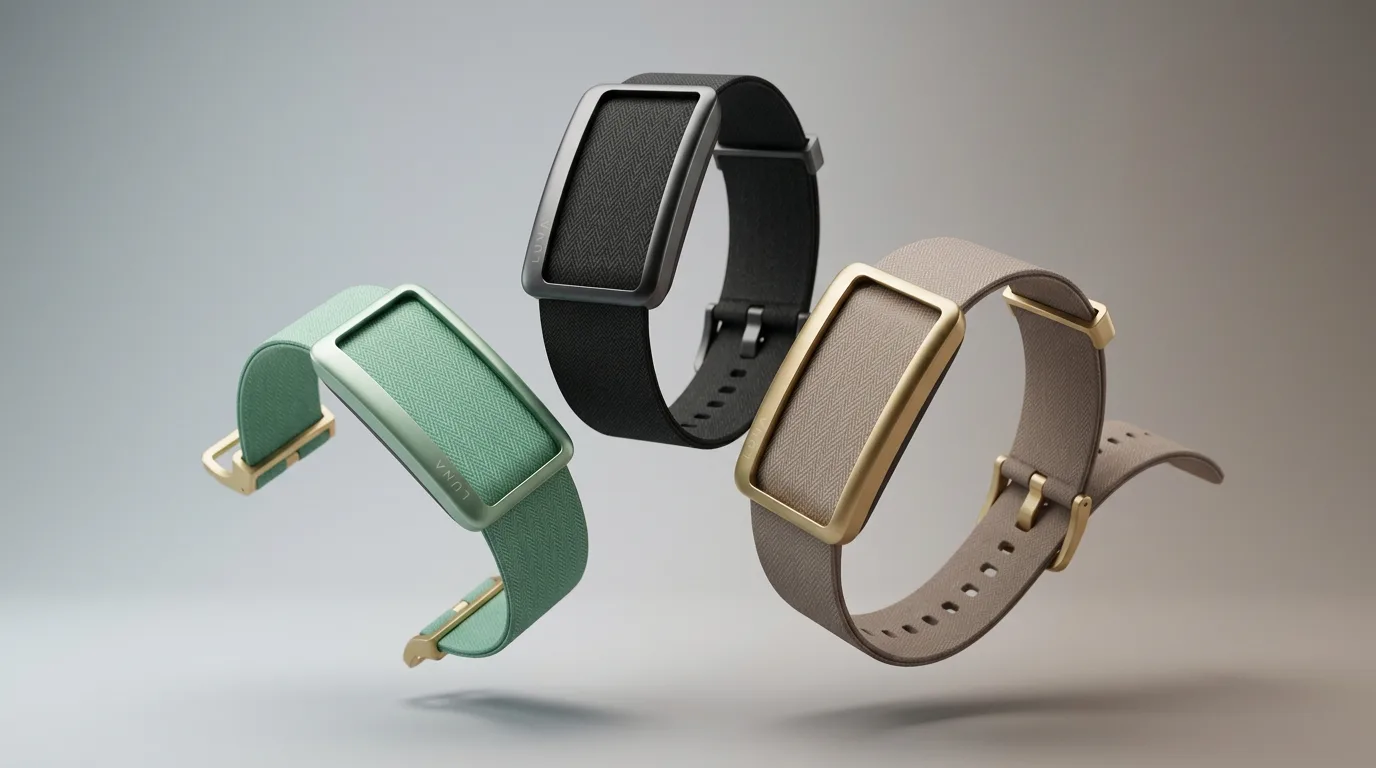
The Luna Band is a screenless wrist tracker from Lunazone, the company behind the Luna Ring. It debuted at CES 2026 in January, opened preorders on July 4, and started shipping Drop 1 on July 31. The price is $149 with no subscription. It comes in matte black, silver, and gold, with cloth and silicone strap options in colors like Aloe Green, Onyx Black, and Desert Beige.
There is no display and no buttons. You wear it and forget about it. The companion app, Luna: LifeOS AI, is where the intelligence lives.
Specs at a glance
| Luna Band | |
|---|---|
| Price | $149 |
| Screen | None |
| Battery | Up to 10 days |
| Sensors | Multi-channel PPG, 6-axis accelerometer, skin temperature |
| Water resistance | Not yet published |
| Onboard GPS | No (uses phone) |
| ECG | No |
| AI coach | LifeOS AI, free (Siri voice on iPhone; Gemini on Android) |
| Apple Health sync | Yes |
| Android support | Yes |
| Voice logging | Yes, via Siri (iPhone only for now) |
| First-year cost | $149 |
The hardware is what you expect from a screenless tracker at this price. It tracks 70+ metrics including sleep, activity, readiness, heart rate, HRV, SpO2, and body temperature trends. It auto-detects workouts like running and general cardio. The battery lasts up to 10 days, which is better than the Apple Watch's 24 hours and the Fitbit Air's 7 days, and comparable to Whoop's claimed 14 days.
What the hardware does not do: no screen, no ECG, no onboard GPS, no blood pressure, no sleep apnea detection. If you need any of those, this is not your device.
LifeOS: the software that matters
The band itself is a sensor pack. The reason to buy or skip the Luna Band is the software. LifeOS is Luna's AI platform, and it takes a different approach from every other tracker on the market.
Most trackers give you a dashboard of numbers and leave you to interpret them. LifeOS tries to do the opposite. It reads your biometric signals and turns them into a plan for your day: when to push, when to rest, when to have coffee, when to get sunlight. It sends haptic nudges on your wrist at moments the app thinks matter. You can also talk to the AI coach through Siri on your iPhone (Android gets Gemini integration but no voice logging yet) to log food, stress, supplements, or anything else that affects your body.
The app ships with a library of what Luna calls "micro-apps": stress, nutrition, training, supplements, and productivity. Each micro-app runs on your own data and context. Luna says users will eventually be able to build custom micro-apps, but that feature is not live yet.
Here is the key selling point: all of this is free. The app, the coaching, the micro-apps. Luna's FAQ states that "the Luna app and LifeOS platform are completely free for all users," with no subscription now or planned.
What is actually shipping vs what is a promise
This is where the review gets honest. The Luna Band went on sale less than two weeks ago. Some of LifeOS's most ambitious features are on the roadmap, not in your hands today.
Shipping now:
- 24/7 heart rate, HRV, SpO2, skin temperature, sleep tracking, and activity detection
- Siri voice logging on iPhone for food, stress, and wellness check-ins
- Haptic nudges based on your daily plan
- Apple Health sync
- The micro-apps for stress, nutrition, training, supplements, and productivity
On the roadmap, not yet shipped:
- Personalized nutrition plans (listed as "part of the LifeOS product roadmap" on Luna's own product page)
- Custom micro-apps built by users
- Gemini voice integration on Android (tracking only for now on Android)
- Blood marker integration (Luna says LifeOS can incorporate bloodwork data, but the input workflow is not fully built out)
- Calendar-aware planning that syncs with your schedule
The coaching itself is partly a promise. LifeOS gives you haptic nudges and daily suggestions today. How smart those suggestions are over months of use is something no reviewer has tested yet, because no reviewer has had months with a shipping unit.
The free coaching problem
This is the part that matters most, and it is where the Luna Band differs from every other tracker in this category.
Whoop charges $199 to $359 a year. Fitbit Air's AI coach (Google Health Coach) costs $9.99 a month or $99 a year on top of the $99.99 device. Apple Fitness+ is $9.99 a month. Oura requires a membership. Every serious AI health coach charges for the intelligence layer because running capable models over personal health data costs real money per user per month. Inference, memory, retrieval, and the engineering around them all carry ongoing costs.
A $149 one-time hardware purchase cannot fund unlimited high-intelligence coaching for the life of the device. The math does not work.
So one of three things is true. The coaching runs on cheap models that will not match what a paid coach delivers. The free tier gets degraded or paywalled once hardware sales slow, which is the classic bait-and-switch. Or the company is burning money on every user, which is not a plan, it is a countdown.
Luna's own product page hints at the gap between promise and delivery. Personalized nutrition plans are listed as a future update, not a shipped feature. When the intelligence is the most expensive part of the product and it is given away, the honest question is what you are actually getting.
This does not mean the hardware is bad. At $149, a comfortable screenless tracker with no subscription and a free app is a real value. The red flag is specific: unlimited high-intelligence AI coaching at that price point is not sustainable, so expect the coaching to be weaker than advertised, or to cost money eventually. The Trusted Reviews hands-on noted that Luna has acknowledged it "may have to add some costs" down the line.
Who the Luna Band is for
The Luna Band is for you if:
- You want a screenless tracker and do not want to pay a monthly subscription
- You like the idea of an AI coach that plans your day, not just your workouts
- You are comfortable being an early adopter with software that is still finding its footing
- You use an iPhone and want Siri voice logging (Android users get tracking only, no voice logging, for now)
The Luna Band is not for you if:
- You need proven, tested coaching that has been in the market for years
- You want a smartwatch with a screen, ECG, GPS, or payments
- You are an Android user who wants the full voice experience today
- You need onboard GPS for run tracking without your phone
Luna Band vs Fitbit Air vs Whoop
| Luna Band | Fitbit Air | Whoop 5.0 | |
|---|---|---|---|
| Price | $149 | $99.99 | $199/yr (band included) |
| Screen | None | None | None |
| Battery | Up to 10 days | Up to 7 days | Up to 14 days |
| AI coach | LifeOS (free) | Google Health Coach ($9.99/mo) | Whoop Coach (included) |
| Voice logging | Siri (iPhone) | No | No |
| First-year cost | $149 | ~$209 with Premium | $199 |
The Fitbit Air is cheaper upfront and has a proven coach behind a paywall. Whoop gives you the coach included but locks you into an annual subscription. The Luna Band splits the difference: cheaper total cost than either, but the coach is an unproven promise.
Where Ness fits
Ness is the coaching layer for whatever tracker you already own. It is an iPhone and Apple Watch app that reads Apple Health (which the Luna Band syncs to) and turns your data into six daily scores: Health, Sleep, Recovery, Strain, Stress, and Energy, computed on-device so the numbers never leave your phone. It logs nutrition deeper than any tracker does natively: a photo, your voice, a barcode scan, or a text search returns calories, macros, micronutrients, and amino acids per ingredient. Its AI coach has memory, web search, and Fast and Pro modes, and it reasons from your actual data (your meals, your sleep, your recovery) instead of answering from a blank slate.
Ness charges for the intelligence layer because the intelligence layer is what costs money, and it is priced at $7.99 a month or $49.99 a year, below Google Health Coach's $99 annual price. That subscription is what pays for frontier models. On HCBenchv1, our internal health-coaching evaluation, Ness Pro scores 93.6%, the highest of any system we have tested, ahead of Claude Sonnet 5 (86.6%), Haiku 4.5 (85.0%), GPT-5.6 Sol (84.0%), Grok 4 (83.9%), and every Gemini variant (81.3% for Gemini 3.6 Flash). The AI features send only anonymized data to zero-data-retention providers.
If you buy the Luna Band, the Fitbit Air, or any other tracker, Ness sits on top of it and gives you the coaching that the tracker alone does not provide.
Sources
- Luna Band product page, Lunazone, fetched August 14, 2026
- Bracaglia D. I just went hands-on with the Luna Band fitness tracker and it beats the Whoop 5.0 in 3 big ways, Tom's Guide, January 9, 2026
- Cesaric-Epple C. Waitlist for the Luna Band, a Screenless Fitness Tracker Unveiled at CES, Is Now Open, CNET, May 21, 2026
- Luna Band vs Fitbit Air, Trusted Reviews, July 2026
- Luna Band pre-order and release dates confirmed, unveils micro apps, Tech Advisor, June 18, 2026
Related reading
Nothing here is medical advice. Wearable data is estimates, not diagnosis. Consult a qualified clinician for any health concerns.