
Blog · September 10, 2026 · 7 min read
The Best Screenless Fitness Trackers in 2026: Whoop MG vs Fitbit Air vs Luna Band vs Garmin Cirqa
Screenless trackers are the wearable trend of 2026. We compare Whoop MG, Fitbit Air, Luna Band, and Garmin Cirqa on price, battery, sensors, and whether the AI coach is actually included.
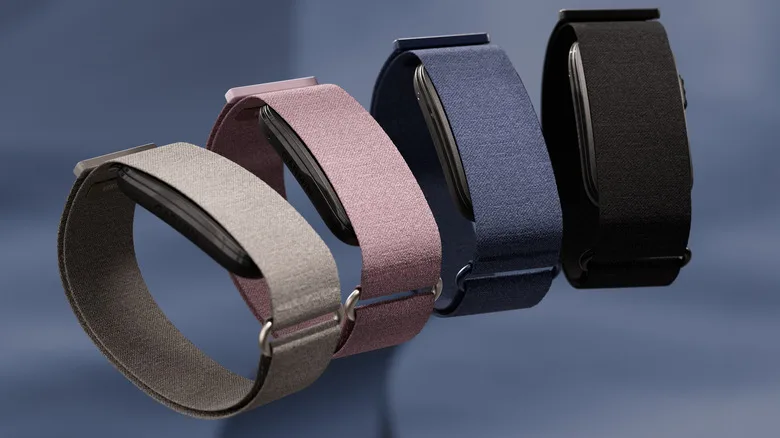
Screenless trackers are the wearable trend of 2026. Whoop started it, Fitbit Air brought it to the mainstream, and Luna Band and Garmin Cirqa have joined it. Four companies now sell a band with no screen that you wear around the clock and forget about.
The hardware is converging. They all track sleep, heart rate, HRV, and activity, and they all last a week or more on a charge. The real question is where the intelligence comes from and what it costs, and that is where these four differ.
The short answer
- Fitbit Air, $99.99, screenless, ~7-day battery, and Google Health Coach behind a $9.99/mo Premium subscription.
- Luna Band, $149, screenless, up to 10-day battery, LifeOS AI free, and Siri voice logging on iPhone.
- Whoop MG, screenless, $359/yr membership (Whoop 5.0 at $199-$239/yr), Whoop Coach included, multi-day battery.
- Garmin Cirqa, $199.99, screenless, up to 10-day battery, no subscription, and no AI coach.
- All four are sensor packs. The coaching layer is the differentiator.
Fitbit Air: the mainstream option
The Fitbit Air is Google's screenless bet. It costs $99.99, has no screen, and lasts up to 7 days on a charge. The hardware is the cheapest entry in this list.
The catch is the coach. Google Health Coach, powered by Gemini, sits behind Google Health Premium at $9.99/mo or $99.99/yr. The device is cheap, but the intelligence is a subscription, so the band plus a year of the coach lands around $200. The three-month Premium trial that comes with the band brings that down. If you want the full product, you pay a membership on top of hardware. That is the same model Whoop uses, just cheaper up front.
Luna Band: the free-coach bet
The Luna Band costs $149, has no screen, and lasts up to 10 days. It tracks 70+ metrics, syncs to Apple Health, and supports Siri voice logging on iPhone. The headline feature is LifeOS AI, a free AI coach with no subscription, now or planned.
The hardware is priced well. The free-coaching economics are the open question, because running capable models over personal health data costs money per user per month and a one-time $149 purchase cannot fund that forever. We covered that in the Luna Band review. The short version is that you should expect the coach to be weaker than a paid one, or to cost money eventually.
Whoop MG: the all-in-one membership
Whoop sells two bands, the 5.0 and the MG (Medical Grade), and you pay for a membership rather than for hardware: $199/yr (One) or $239/yr (Peak) for the 5.0, and $359/yr (Life) for the MG. There is no hardware-only option.
The membership buys Recovery, Strain, and Sleep scores, Whoop Coach, and a multi-day battery that charges on the wrist, claimed at up to 14 days. Whoop is the most mature of the four, with years of score data and a coach that is part of the membership rather than an upsell. The trade is the price: it is the most expensive first year in this list, and you keep paying every year or the band stops working.
Garmin Cirqa: the no-subscription answer
The Garmin Cirqa is the newest of the four, launched in July 2026. It costs $199.99, has no screen, lasts up to 10 days, and has no subscription at all. It tracks the same sleep, recovery, HRV, and activity signals as the others, and DC Rainmaker's hands-on found it covers essentially every health and fitness tracking feature of Garmin's sub-$500 GPS watches.
What it does not have is an AI coach. Garmin gives you the data and the scores and stops there. That is either a feature or a gap, depending on what you want. If you just want recovery numbers without a monthly bill, it is the cleanest option here.
The comparison
| Fitbit Air | Luna Band | Whoop MG | Garmin Cirqa | |
|---|---|---|---|---|
| Price | $99.99 | $149 | $359/yr (device included) | $199.99 |
| Screen | None | None | None | None |
| Battery | Up to 7 days | Up to 10 days | Up to 14 days | Up to 10 days |
| AI coach | Google Health Coach ($9.99/mo) | LifeOS (free) | Whoop Coach (included) | None |
| Subscription | $9.99/mo or $99.99/yr | None | $359/yr (5.0: $199-$239/yr) | None |
| First-year cost | ~$200 with Premium | $149 | $359 | $199.99 |
| Apple Health sync | Yes | Yes | Yes | Yes (via Garmin Connect) |
The subscription math
Each tracker prices the intelligence layer differently.
Cheap hardware, paid coach. The Fitbit Air has the lowest entry price, then a subscription for the intelligence layer. You pay $99.99 to start and $99.99/yr after that if you want the coach.
Membership bundles everything. The Whoop MG device is "free" but the membership is mandatory and the most expensive here. You are renting the whole system, hardware included, year after year.
Hardware only, no coach. The Garmin Cirqa is a one-time purchase. You own the band, keep the data and the scores, and get no AI layer at all.
Free coach on cheap hardware. The Luna Band promises a free AI coach with no subscription, which is the biggest claim in this list and the hardest to sustain. A $149 one-time purchase cannot fund unlimited high-intelligence coaching for the life of the device. The free coach is either running on cheaper models, or it will not stay free.
The intelligence layer is the expensive part of these products, and you pay for it one of three ways: a subscription from Fitbit or Whoop, a higher one-time price and no coach from Garmin, or a bet that the free coach is real from Luna.
Where Ness fits
All four are sensor packs. The band collects the data, and something else has to turn it into a plan.
Ness is that layer for iPhone and Apple Watch users. It reads the Apple Health data your band syncs and turns it into six daily scores: Health, Sleep, Recovery, Strain, Stress, and Energy, all computed on your phone. It logs food by photo, voice, barcode, or text search and returns calories, macros, ~40 micronutrients, and 11 amino acids per ingredient. The AI coach has memory and web search, and it reads your meal log alongside your sleep and recovery.
None of the four bands log nutrition natively. Ness adds that plus the coaching on top of whichever sensor pack you choose. Its AI features send anonymized queries to zero-data-retention providers after stripping personal details like your name. A free trial comes first, then $12.99/month or $79.99/year. Ness is not a medical device.
How to choose
- Fitbit Air if you want the cheapest hardware and you are fine paying for a coach.
- Luna Band if you want no subscription at all and you are an early adopter.
- Whoop if you want a proven 24/7 band with scores and a coach included.
- Garmin Cirqa if you want Garmin's ecosystem, no subscription, and no coach needed.
- Ness if you want the best coaching layer on top of any of them.
Sources
- Google. Introducing the all-new Fitbit Air. May 7, 2026. https://blog.google/products-and-platforms/devices/fitbit/fitbit-air/. The $99.99 price, the screenless design, the week-long battery, and Google Health Coach.
- Lunazone. Luna Band. https://www.lunazone.com/products/luna-band. $149, up to 10-day battery, LifeOS AI free, 70+ metrics, Apple Health sync.
- Whoop Support. Membership Pricing. https://support.whoop.com/s/article/Membership-Pricing. Whoop One $199, Peak $239 (5.0), Life $359 (MG), device included.
- Garmin Newsroom. Meet CIRQA Smart Band: The screen-free health and fitness tracker from Garmin. July 21, 2026. https://www.garmin.com/en-US/newsroom/press-release/wearables-health/meet-cirqa-smart-band-the-screen-free-health-and-fitness-tracker-from-garmin/. $199.99, no subscription, up to 10-day battery.
- TechRadar. Garmin Cirqa review: sorry Fitbit, but this is 2026's best screenless tracker. August 6, 2026. https://www.techradar.com/health-fitness/fitness-trackers/garmin-cirqa-review. $199.99 with no subscription fee.
- DC Rainmaker. Garmin Cirqa Hands-On: Everything You Need to Know. July 21, 2026. https://www.dcrainmaker.com. $199, covering essentially every health and fitness feature of Garmin's sub-$500 GPS watches.
Nothing here is medical advice. Health apps and wellness scores are tools, not diagnoses; if you have symptoms or a health condition, see a physician.