
Blog · September 18, 2026 · 12 min read
ChatGPT as a Health Coach: What It Gets Right
Plenty of people use ChatGPT for health advice. We look at what it does well, where it fails, and when a dedicated health app is the better tool.
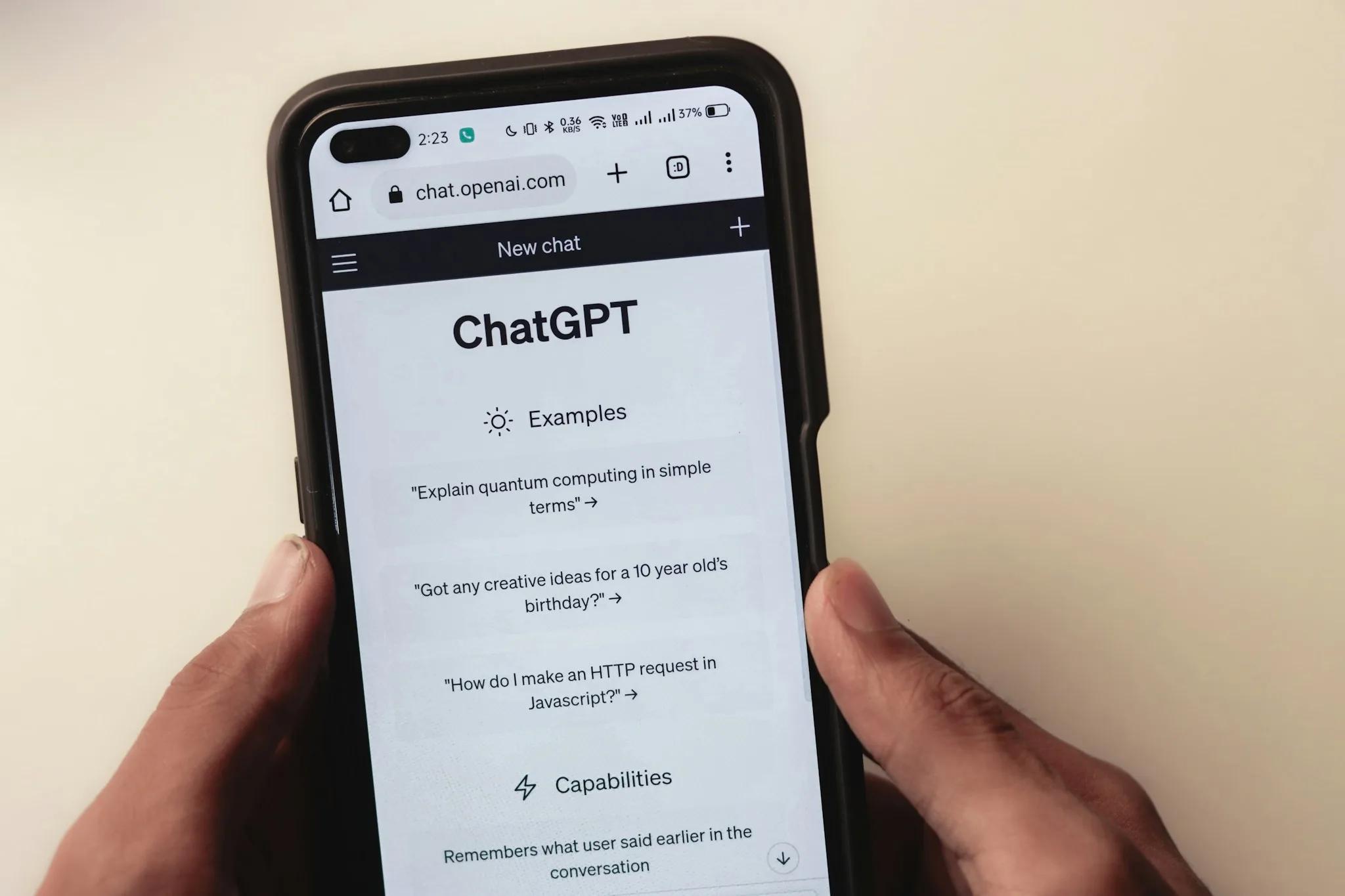
You have probably done it. You type a question into ChatGPT at 11 pm. Something about your sleep, your diet, a lab result you did not understand. The answer comes back in seconds, organized, confident, and easy to read. So a fair question follows: can I use ChatGPT as a health coach? You can use it for parts of the job. It is good at plans, explanations, and motivation. It is bad at the part that matters most, which is knowing what is actually happening in your body.
That is not a guess. In 2024, a peer-reviewed study put ChatGPT in front of real patients for two weeks and asked them to use it as a virtual health coach. The patients liked a lot of what they saw. They also ran straight into limits that a chat window cannot fix, because the limits are about data, memory, and privacy, not wording.
This piece walks through both sides. What ChatGPT genuinely does well as a health coach, where it falls down hard, what the research actually found, and when you should close the chat and talk to a human.
The short answer
- ChatGPT is good at generic health work: meal plans, workout templates, explaining lab results in plain language, and motivation chat.
- It cannot see your real data. It has no access to your Apple Health, your watch, or your lab trends unless you paste them in one at a time.
- It does not reliably remember your history between chats, so it cannot track your progress over months.
- It can state wrong numbers with total confidence. OpenAI's own terms tell you not to rely on it as a substitute for professional advice.
- It works as a supplement for generic plans. It is not a coach that reads your body's signals, and it never replaces a doctor for anything serious.
What ChatGPT genuinely does well
Start with the strengths, because they are real.
Meal plans. Ask for a chatgpt meal plan and you will get a competent one. Give it your calorie target, your budget, the foods you hate, and the 20 minutes you have for dinner, and it will hand back a week of meals that fit. This used to be something you paid a dietitian or a coach to draft. For a healthy person who just needs structure, a generated meal plan is a genuinely useful starting point. The catch comes later in this article: the plan is generic the moment the model forgets you, and it knows nothing about how your body responds to the food.
Workout templates. Same story. "Write me a 3-day beginner strength program with dumbbells only" is a solved problem. The output is usually sensible, progressive, and safer than a random influencer post, because the model draws on a huge body of published training guidance. People have even used it to prepare for serious athletic goals, and the 2024 study below recorded patients building walking and yoga habits with its help.
Explaining lab results in plain language. This is where the tool shines. Paste a lipid panel or a thyroid result and ask what it means, and you get a calm, readable explanation of what each marker measures. Studies have repeatedly found that large language models are good at simplifying medical text for regular people. If your doctor used a word you did not catch, ChatGPT is a better first stop than a spiral of search results. Use it to understand your results, not to act on them.
Motivation and accountability chat. Some people just need to think out loud at 6 am before a run. A chatbot is always awake, never bored, and does not judge you for falling off the plan. In the study below, patients said the tool helped them change behavior, set goals, and stay motivated. That is a real coaching function, even if the coach does not know you deeply.
None of these are small things. For a healthy adult who wants generic structure, ChatGPT delivers a lot of value for free. The trouble starts when you ask it to be a coach rather than a content generator.
Where ChatGPT fails as a health coach
A coach does four things: watches your data, remembers your history, gets the facts right, and keeps your information safe. ChatGPT fails at all four, in different ways.
It cannot see your actual health data. ChatGPT has no access to your HealthKit, your watch, your resting heart rate, your sleep stages, or your step trends. It only knows what you type. You can paste in a week of numbers, but that is a snapshot, not a feed. A coach that cannot see your baseline is guessing. If your resting heart rate has crept up three beats over a month, or your deep sleep collapsed after a medication change, a chatbot has no way to notice unless you happen to mention it. The whole value of health tracking is in the trends, and the trends live on your devices, not in the chat.
It has no reliable long-term memory of you. Chat history features exist, but you cannot count on the model connecting what you told it in March to what you ask in September. Ask it to adjust your plan and you will find yourself re-explaining your weight, injuries, schedule, and preferences again and again. Real coaching is cumulative. Without durable memory of your trends, ChatGPT restarts from zero every few conversations, and a plan built on forgotten context is a generic plan.
It states wrong numbers confidently. Language models generate plausible text, not verified facts. They can invent a calorie count, misquote a study, or give a supplement dose that is simply wrong, and the answer reads exactly as confident as a correct one. A 2026 audit in BMJ Open tested five popular chatbots on 250 health questions in misinformation-prone areas. Experts judged almost half the responses, 49.6 percent, as problematic, and about one in five as highly problematic. Worse, when asked for citations, the chatbots produced references that were largely incomplete or inaccurate. The models also scored poorly on readability, writing at roughly a college level even for health topics. Confident and wrong is the most dangerous combination a health tool can have.
It carries no health-data privacy commitment. A doctor's office is bound by medical privacy law. ChatGPT is not a medical service, and OpenAI's own terms of use, updated January 1, 2026, are blunt about it. The terms say output may not be accurate, that you should not rely on it as a substitute for professional advice, and that you must not use output for medical decisions about a person. On privacy, the terms say OpenAI may use your content to develop and improve its services. You can opt out of model training, but the frame is a consumer software agreement, not a healthcare one. Before you type symptoms, medications, or test results into a chat, remember that you are sharing them with a company whose own contract tells you not to lean on it for this.
What researchers found when real patients tried it
The clearest evidence comes from a 2024 study by Fahad M. Al-Anezi, published in the journal Learning Health Systems. Twenty-nine outpatients at a Saudi university hospital, most managing chronic conditions like diabetes or kidney disease, used ChatGPT 3.5 as a virtual health coach for two weeks, at least 15 minutes a day. Then researchers interviewed each of them at length.
The participants saw real upside. Nearly all of them, 26 of 29, said ChatGPT helped them learn about their conditions and improve their health literacy. All 29 called it cost-effective. Most found it engaging and easy to use, and 18 of 29 said it helped them change behavior, with some reporting they walked more, slept better, or lost weight during the two weeks.
They also hit every wall described above, and then some. Almost all of them, 27 of 29, said the lack of physical examination was a major concern, since the chatbot only knew what they typed and could miss symptoms they forgot to mention. Nearly half, 14 of 29, worried about privacy and the security of the health data they were sharing. Twenty-five of 29 said the tool was unsafe in emergencies, with one patient noting he could not rely on it during chest pain. One diabetic patient with several complications found ChatGPT could not connect his conditions the way his doctor did, because it treated each problem separately. And many noted the tool kept deflecting them back to human professionals, which is polite, correct, and a signal in itself.
The study's conclusion matches the practical read: ChatGPT-based tools may serve as a supplementary support system for managing health, but they must protect privacy and are not a replacement for care. The researcher flagged ethics, privacy, and legal questions that must be resolved before a chatbot can act as a trustworthy health coach.
A second line of evidence points the same way. The BMJ Open audit mentioned above found that chatbots performed worst exactly in the areas a would-be health coach gets asked about most: nutrition and athletic performance. The authors recommended that people be extremely critical of chatbot health advice and default to consulting human specialists before acting on it.
When to see a human professional instead
A chatbot is a supplement. See a doctor, and skip the chat entirely, in these cases:
- Any symptom that could be serious. Chest pain, trouble breathing, sudden weakness, unexplained weight loss, blood where there should not be blood. Emergency first, chat never.
- New or changing symptoms. A chatbot cannot examine you. Describe symptoms to it and it can only pattern-match your words, and anything you forget to mention changes the answer.
- Medication questions and dose changes. Wrong numbers here cause real harm. Ask the pharmacist or the prescriber.
- Chronic conditions with complications. The study found ChatGPT handled simple, single-condition questions well but failed to connect complex cases. That is exactly when you want the human.
- Pregnancy, kids, and mental health crises. These need licensed humans, full stop.
- Anything you would act on for someone else. OpenAI's terms specifically forbid using output for medical decisions about a person. That is the company telling you where the line is.
A reasonable rule: if the question has a generic answer that applies to most people, ChatGPT is fine. If the answer depends on your specific body, history, or numbers, use a tool that can actually read your data, or a professional who can.
FAQ
Is it safe to share health data with ChatGPT? Treat it like any consumer app, not like a doctor's office. OpenAI's terms allow the company to use your content to develop and improve its services, with an opt-out for model training. There is no HIPAA-style protection for what you type. Sharing a general question is low risk. Pasting detailed medical records, medications, and test results is a decision to make with that in mind.
Can ChatGPT replace a personal trainer? For writing a program, mostly yes. For coaching, no. A good trainer watches your form, reads your energy, adjusts when your sleep falls apart, and remembers your knee injury without being reminded. ChatGPT can generate the plan but cannot observe you. Use it for the template, use a trainer or a data-connected app for the feedback loop.
What should I never ask a chatbot? Do not ask it to diagnose you, to clear you for exercise after a health event, to adjust a medication dose, or to interpret an emergency. These are questions where a confident wrong answer causes damage, and the BMJ Open audit shows chatbots produce confident wrong answers at a meaningful rate.
Is ChatGPT good for health advice in general? For general education, it is often good. For personal medical advice, it is the wrong tool, and OpenAI's own terms say not to rely on it as a substitute for professional advice. The useful version is: let ChatGPT explain, let a data-connected tool or a clinician advise.
Does ChatGPT remember my health history between chats? Not reliably. Memory features vary and you should not bet your coaching on them. Assume each conversation starts fresh, which means any plan it builds for you today can drift from the plan it built last month. Consistency over time is the core of coaching, and this is the model's structural weak point.
What is a better alternative for tracking my health? Use the right tool for each job. A wearable plus a health app that reads your real data handles the ongoing picture. A clinician handles diagnosis and treatment. ChatGPT handles the generic questions in between.
Sources
- Exploring the use of ChatGPT as a virtual health coach for chronic disease management, Learning Health Systems (Al-Anezi), January 2024.
- Terms of Use, OpenAI, effective January 1, 2026.
- Study finds popular AI chatbots often give problematic health advice, News-Medical, April 2026, covering Tiller et al., BMJ Open, April 2026.
Related reading
- The best AI health assistant in 2026
- AI health coaches: can you trust them?
- Apple's AI health coach is dead. Here is what that means
- The best AI health coach apps
So where does that leave the question? Use ChatGPT for what it is: a fast, cheap generator of generic plans and plain-language explanations, and an always-awake motivational chat. Do not use it as the coach that reads your body's signals, because it cannot see your data, cannot remember your trends, and its own terms of use tell you not to trust it for medical decisions. If you want a coach that actually knows your numbers, that is what we built Ness for. Ness turns your Apple Watch and Apple Health data into clear health scores, and an AI coach that reads those scores and tells you what to do next, with your data handled as health data, not as training material for a general-purpose chatbot. It costs $12.99/mo monthly or $79.99/yr yearly, and you can download it on the App Store.
Nothing here is medical advice. Health apps and wellness scores are tools, not diagnoses; if you have symptoms or a health condition, see a physician.